Saturday, February 8, 2014

Project002_SurfaceFlow (week2)


 Final: making face : (

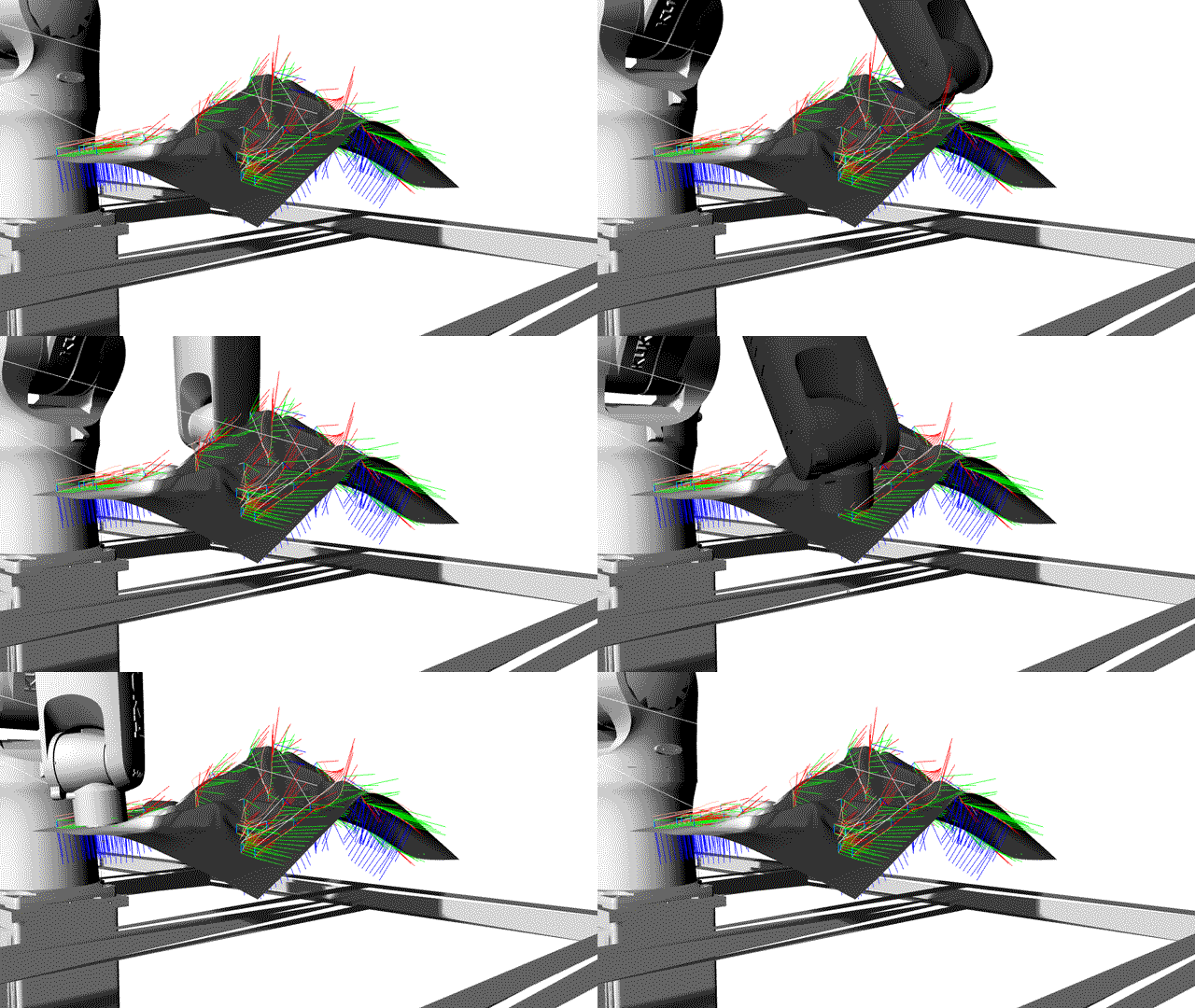
1, get a surface by patching the meshes from scanning model, then generate flows from grasshopper by Sonicflows in grasshopper

2, pick several flows that have different features

3, generate the tool path using ordered_reference under motion options
in SuperMatterTool

4, tie the pen onto the robot bit

5, teach robot the tool by calibrating it carefully

6, try calibration for the last time and luckily it works

7, locate the dimension of the model at 3 points (it doesn't turn out well and it might be better if try to draw out the edge of the surface)

8, draw onto the surface (it doesn't work out well because: a, The tool in robot settings resets to default every time it runs; b, due to the mechanism that SuperMatterTool holds, there usually is an error on No 4 anchor or No 5 anchor)

9, debugging: you need to position the A4 to run some of the failing paths


10, drawing on the surface


11,  : )  vs  : (

Lesson: Let's start simple, and make fun : )

12, the pengripper got finally print out...


Monday, February 3, 2014

Manufacturing the Bespoke / Yun

Reading Response: 
Manufacturing the Bespoke by Bob Sheil (pages 78-87)

Sheil raises the point that robots should be and are now more integrated in the architecture design process, which leads to a question of the levels of automation--will it be a good idea to program an entire building as a single construction process? It may make economic sense to make use of a tool as frequently as possible, and it certainly seem to reduce the number of separate steps of construction. However, it is ironic that a tool--the robot--so flexible for unique building situations may precisely become a tool of mass production. People today sell generic plans and sections to land owners; in the future, people can be selling digital description files for robotic fabrication. In addition, what are then, the new roles of the architect and the builder? Will the builder become the duplicator and the architect become the space programmer? 

Reading Response: Manufacturing the Bespoke (P78-P87)


By tracing back the history of robots,  Bob Sheil points out that the role of robot has been shifting from predominantly regarded as advanced manufacturing and construction tools to programmable design tools, and thutheir flexible potentiawas becoming focused at designers. Control software and physical intervention in fabrication process expands the outdated working range for robot. Thus automation is combined with aarchitecturaculturin whicdesign and constructioare intrinsicalltied to one another, and by using throbot not only as a means for automation but as a design toolthe goal ito engineer not perfect and widely applicable fabrication process but unique one. 
My gain from this is becoming aware of the flexibility that brought by various programing applications. It also raise a question by the extreme accuracy from robot is that: taking a look at the work of laying brick as an example, I consider the random inaccuracy as a recall of human creativity, which might arose the emotional effects. I wonder if there is a day for robot programming to become complex enough to simulate such random inaccuracy? If it is, will that be a mimic or an overcome for human creative activity?

yi

Project002_SurfaceFlow (week1)


Final Simulation of drawing along the flows


Melting Wax

Dipping

Layout

Form Finding


Digitizing (Failure due to the Digitizer)

 Before 3D Scanning


Surface after 3D scanning and Refinement


 -team robodance

Manufacturing the Bespoke


With a limited understanding of the potential of the robot, I question how it may open potential within architectural design, how does the robot move beyond the capacity of replicating and replacing human labor, what are the capacities of it as a design tool? I am little interested in terms of optimization or economic efficiency or mere repetition of standard processes, rather is there potential for the robot to be ‘greater’ than the human hand in a differing capacity? To work in extreme conditions? To reach new heights, etc? The article seems to suggest that specification in construction operations and materials can lead to a new craft culture combining digital and physical, blurring boundaries between structural order and ornamentation, but what is the potential for craft when a process of creation becomes a wholly automated output of digital description? A one-to-one process. The potentials are interesting and obviously require a more in-depth knowledge of the robot operation, and perhaps a sort of ‘hacking,’ part of the reason I’m in this class.

-Missy

Tuesday, January 28, 2014

Encoding Material / Yun

Reading Response: 
Encoding Material by Fabio Gramazio, Matthias Kohler, Silvan Oesterle (pages 108-115)

When we have access to robotic fabrication, thus decreasing the gap between design and fabrication, we return to perhaps the state of architects at its original form--builders. This way, we have a closer understanding of concepts such as gravity and materiality. I suspect, however, that we will have a slightly different idea about construction and assembly, simply because the tool we now use is a robot instead of hands (or hands of others). The basic logics may be kept the same, but the level of precision, persistence, size, and strength that the robot offers allows for new methods of making, and hence new types of spaces. Some say that material drives design, but maybe all steps and aspects of designing and building drive the product. Tools also drive design. 

Saturday, January 25, 2014

Project001_RoboSaga (week2)

Here it is, our robot-squiggle-light-jump-dance-sketch-team-selfie! 


the dance continues as Yi runs away from the Pouncer, Monster and Flying Man with Sword


Again, some progress report. First we tested with a simple wavy curve as Dan grew a conjoined twin and Missy documenting the scene. 


Then, this: 


Coming next is probably another type of elaborate robot drawing scheme. Stay tuned!